Business intelligence for collection floors
Your accounts are ranked. Your collectors aren’t.
You put real thought into which accounts to work first. Then each one goes to whoever is free next, as if every collector were the same. BestPair learns from your own call and payment history which collector should work which account.
In under two minutes
What is it costing you?
Work it out with your own numbersWhere predictive pairing comes fromRead the transcript
Is this your shop?
If any of these is true, you’re probably wasting your time.
Pairing needs enough history to learn from and room for your results to improve. Without both, there is very little for it to work with.
- You have fewer than 25 collectors.Too few work each kind of account to tell skill from luck.
- You don’t have a year of call and payment history.That history is what pairing learns from.
- You know almost nothing about the consumers you call.If an account is just a phone number and a balance, there is nothing to tell one account from another.
- More than half your right-party contacts already end in a payment.There is little room left for better matching to find.
Still here? Let’s see what this could be worth on your floor
Any dialer works: predictive, progressive, preview or power, set up the way you run it. What we look for on each account
Your floor, our model
What pairing could be worth on your floor
Three numbers: two off your dialer report and one off your collections report. What comes out is purely illustrative: at best informed guesswork, until the Floor Assessment measures it on your own history.
The model needs JavaScript. In short: lift on collections is BestPair’s model strength, times the value of having a choice of agent, times your conversion headroom, capped at 20%.
Where to find these numbers
- Agents
- Seats in the hunting pool, not headcount: the agents the dialer can choose from. Your dialer report has it.
- Conversion
- Right-party contacts that end in a payment or an arrangement, from your dialer report. Lower conversion leaves more room to move it.
- Collections
- What the floor collects in a month, from your collections report. The lift applies to this.
Illustrative only. At best, informed guesswork.
Lift on collections
5.3%
Band 3.7% to 6.9%
Extra per year, before fees
$316K
Band $222K to $411K
- $26Kextra per month
- $285Knet to the agency per year
A modelled estimate from your three numbers, shown as a range. The Floor Assessment replaces the guesswork with a measurement from your own history before anything is promised.
How it works
Two stages. A report first, then pairing if your own history earns it.
Stage 1 shows what your history says. Stage 2 puts it to work on your floor, measured every month against a control group.
Stage 1
The Floor Assessment
We read up to 24 months of your own history and show which agents are best with which accounts, and what pairing would have been worth on your floor. At the same time we build the models Stage 2 runs on, so we are ready the day you decide. A fixed $15,000, and nothing changes on your floor. You keep the report, whatever you decide next.
What the report containsYour decision
We take your team through the report. Stage 2 starts on the 1st of the next month, with the models already built, unless you opt out in writing within 10 business days, at no further cost. You keep the report either way.
Stage 2
Live pairing
We decide which collector works each account, and the dialer you already run does the dialing. 80% of accounts are paired, 20% stay on your current routing as a control. You pay 10% of the extra collected against that control, with a $2,500 monthly minimum, and the $15,000 is credited against fees above the minimum.
How you would know it is workingStage 1
The Floor Assessment
A report on your agents, built from your own data, and the models Stage 2 runs on, built at the same time. It tells you what your history says. What you do about it is your call.
- $15,000Fixed fee
- 4 weeksFrom the day we confirm your data
- 0Changes to your dialer or software
- $15,000Credited against Stage 2 fees above the minimum
What the report contains
- The spread between your agents on the same kinds of accounts, measured from your history.
- Where the accounts arriving on your floor do not match the strengths of the agents working them.
- A profile of every agent: where each one is strongest and weakest, with a coaching note.
- Actions you can take without us: coaching, hiring and scheduling.
- What your own history suggests pairing would have been worth, as a range, with a one-page business case for your decision-makers.
If you go on to Stage 2, it is credited against your fees
The $15,000 is credited against Stage 2 fees above the $2,500 minimum. Credit still unused 12 months after Stage 2 starts, or when Stage 2 ends if sooner, lapses.
What it does not promise
A result. The range in the report is what your history suggests, not a forecast of what you will collect. If your agents turn out to be too alike on the same kinds of accounts for pairing to matter, the report says so in plain words. You keep it either way.
What you pay if it does not work
Two cases. The report shows no gain, or you decide to stop there: opt out within 10 business days of the readout, and you have paid for a report you keep, with nothing further owed. Once Stage 2 is live, a month with no gain costs the $2,500 minimum.
Read the full pageStage 1 · what you get for $15,000
An eight-page report on your own floor
Four weeks after your data arrives, this is what lands on your desk: every agent, every kind of account, and what your own history says about who should work what. The pages below are from the sample report, built on a fictional floor with synthetic data, so you can see exactly what you get before you send us a single file.
-
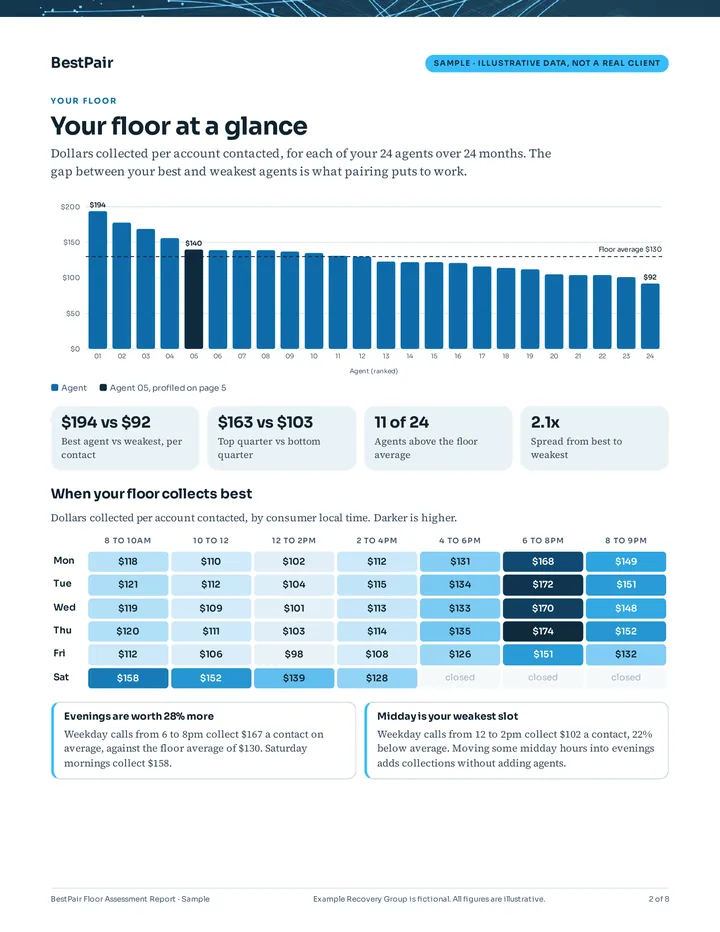
Your floor at a glanceDollars collected per account contacted, for every agent side by side: the spread between your best and weakest, and the hours when your floor collects best. -
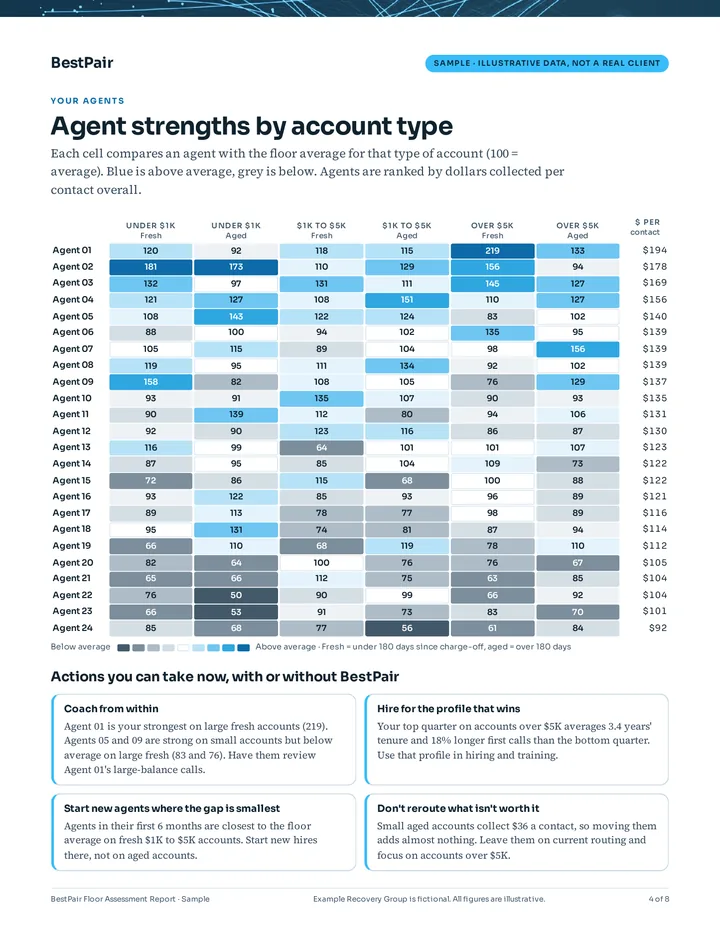
Agent strengths matrixEvery agent against the floor average on each kind of account, with the actions you can take now: who should coach whom, who to hire, and where to start new agents. -
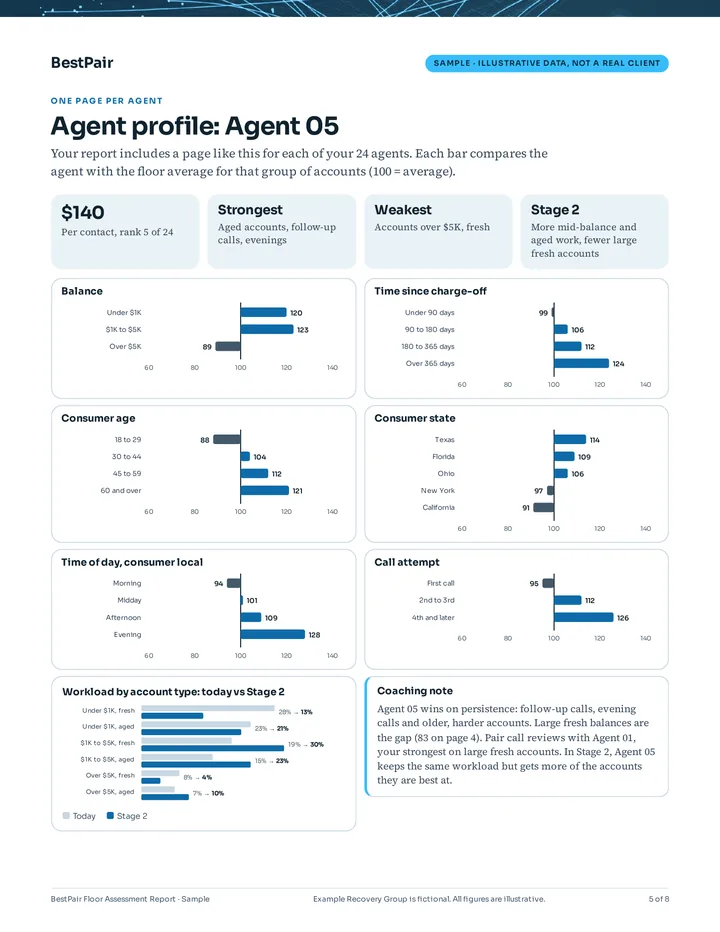
A page on every agentWhat each collector is strongest and weakest on, with a coaching note, and what changes for them in Stage 2.
Also inside: what is arriving on your floor against who does well on it, where your current routing leaves money, a scorecard of your data, a one-page business case for your decision-makers, and how every number was built.
Walk through all eight pages
In the order you would read them: the estimate for your campaign, your floor at a glance, what is arriving against who does well on it, agent strengths, a page on every agent, where routing leaves money, the business case, and how every number was built.
Read the full pageThe full sample runs to 8 pages. PDF, 1.2 MB. A fictional floor and synthetic data, not a client.
Stage 2
Live pairing, and how you would know it is working
Your collectors, your dialer and your dial volume stay the same. What changes is who works each account. For preview dialing we post one file of assignments a day, each account to a named collector, loaded the way you load lists today. For predictive, we work through your dialer’s own skills-based routing, which delivers our assignments as it routes calls today. Progressive and power dialing use whichever of the two your dialer supports, set up with your dialer lead before Stage 2 starts.
-
A control group, every month
In Stage 2 accounts are split at random. 80% follow BestPair’s assignments, 20% stay on your current routing. The difference between the two is the result. Nothing else counts.
-
The number is on the invoice
Every monthly invoice carries a results statement: paired accounts against control, per account contacted. You pay 10% of the extra collected against the control group, with a $2,500 monthly minimum. The Stage 1 credit is applied against fees above the minimum, never the minimum itself.
-
You can leave
Stage 2 can be ended within the first 90 days on 30 days’ written notice. If the results statement does not show the difference, you stop, and you still have the report. After 90 days the 12-month term applies.
How the extra is measured
Accounts are split at random as they arrive: 80% to BestPair, 20% left on your current routing. Each month both groups are scored on dollars collected per account contacted, and the extra is the difference, times the BestPair accounts contacted.
Read the full pageThe agency in the live test is not named on this page. When a client agrees to take reference calls, we will put you in touch. Meanwhile your own floor is measured the way that test was: against a control group, every month.
Objections, answered
The questions owners ask first
Straight answers. The full security overview and data guide are yours on request.
What happens to my data, and the PII in it?
We never ask for PII. The Assessment runs on pseudonymised records: your own account and agent IDs, call dates and outcomes, payment dates and amounts, and account attributes such as balance, days delinquent, state and age band. No consumer names, Social Security numbers, phone numbers, email or street addresses, or bank details. If a file arrives with something we did not ask for, we delete the upload and ask you to send it again without it.
Files come in over encrypted SFTP and are stored and processed on AWS in the United States, encrypted at rest. Datamize, Inc. holds a SOC 2 Type 1 report covering Security, Availability and Confidentiality, available under NDA. For healthcare accounts we sign a Business Associate Agreement.
Do I have to replace my dialer?
No. BestPair is dialer-agnostic by design. Stage 1 works from files your dialer and collection platform already export. In Stage 2 we send you daily assignments, or segments for your dialer’s own skills-based routing, and your dialer keeps doing the dialing. We do not sell dialers and have no reason to want you to switch.
What changes for my agents during Stage 1?
Nothing. Stage 1 reads your history. It does not touch your floor: no software to install, no new screens, nobody listening to calls. Your agents will not know it is happening unless you tell them. What you do with the agent pages afterwards is up to you.
What happens to my data afterwards?
We keep it only for the engagement. Within 30 days after it ends, or sooner if you ask in writing, we delete it from active systems and confirm that in writing. Encrypted backups roll off within 90 days. Models trained on your data belong to BestPair and may be kept after the engagement ends, as our Standard Terms set out. Your data itself is deleted as above, and we never sell it.
Why not just give my best collectors every account?
Because your best collectors run out of hours, and “best” is an average that hides specialists. A collector who looks middling overall can be your strongest on aged, low-balance accounts. Pairing sends each account to the collector who does best with that kind, so work spreads across the floor instead of piling onto the top few.
Read the full pageMy platform already has predictive routing. Why this?
Same idea, asked differently. Platform routing usually decides who takes a call as it arrives, and learns from what happened on the call. Collections is judged on dollars collected, which land days later in your collection system. BestPair decides which collector owns each account, works with the dialer you have, and is checked every month against a control group.
Read the full pageCould we build this ourselves?
A large agency could build a version of it. The question is whether it would beat our fee: 10% of the extra we collect, with a $2,500 monthly minimum, so you keep 90% of the extra. An in-house build needs a standing team to keep it right, carried by one floor. We could not run BestPair on a single large agency, and most agencies get a better return from training collectors and winning new placements.
Read the full pageWhat happens next
From this page to live pairing
Six steps. Only the first one happens before you decide anything.
-
Fit call
We check your floor size and your data. If it does not fit, you hear that on the call.
-
Order form
A short order form plus our standard terms, signed electronically.
-
Data transfer
Up to 24 months of history over encrypted SFTP. We check it within 2 business days and confirm in writing.
-
Build
The clock starts the day we confirm your data. We build your report and the models Stage 2 runs on. Nothing changes on your floor.
-
Readout and your decision
We take your team through every page. Stage 2 starts on the 1st of the next month, unless you opt out in writing within 10 business days.
-
Live pairing
Set up with your dialer lead. Every invoice carries the result: paired accounts against the control group.
Dig deeper
Everything behind this page, for you and for whoever you forward it to. Each one opens here, and closing it brings you back to where you were.
- The live test, in full170,000 telecom accounts split at random before the first call: how it was run, what was counted, and its limits.
- The sample report, page by pageEvery page of the report, in order, shown on a fictional floor built from synthetic data.
- The four files, field by fieldCalls, payments, agents and account detail, keyed to your own IDs, with nothing that names a consumer.
- What we look for on each accountThe debt and the consumer, field by field: what is required, what helps, and what we never ask for.
- What your dialer needs to doNothing changes in how it dials. What changes is which collector gets each account, and how that reaches your dialer in each mode.
- How the extra is measuredA random 80/20 split against your current routing, scored every month on dollars collected per account contacted.
- What you pay if it does not workWhat stopping after the report costs, and why a month with no gain costs the $2,500 minimum.
- Why not give your best collectors every account?Your best collectors run out of hours, and one overall ranking hides the specialists on your floor.
- Our platform already has predictive routingThe same idea asked differently: who owns an outbound account, judged on dollars collected, checked against a control group.
- Could we build this ourselves?Our fee is 10% of the extra. Beating that in-house means a standing team carried by one floor, and time taken from what an agency does best.
- One-page summary for your bossWhat it is, what it costs, what it needs from your side and the risk, on one page to forward.
A live test, not a story
Same book. Same agents. More cash collected.
A North American collection agency split a telecom book in two, at random, before anyone dialed. One half went to the agent BestPair matched it to. The other half ran on the usual process. Same dialer, same agents, same weeks.
- $98.76Collected per account reached, matched by BestPair
- $79.17Collected per account reached, on the usual process
- 25%More collected per account reached (24.7%, rounded)
- 170,000Telecom accounts, split 50/50 at random before the first call
-
Split before dialing
84,762 accounts to BestPair and 85,119 to the usual process, with balances matched across both halves. Nobody chose which accounts went where.
-
BestPair recommends, the dialer decides
For each account, BestPair named the best-matched agent. The dialer routed the call to that agent when they were free, and to whoever was free when they were not. BestPair never chose who got called.
-
Every reached account counts
Cash collected in the 30 days after each account’s first real conversation, whether or not the dialer followed the recommendation. The largest 1% of payments were trimmed, so one large payment cannot swing it.
What it shows, and what it does not
In May the matched half collected $23,096 more cash than the usual half. The difference came from more cash from the accounts that paid, not from more people paying. It is one book in one month, May 2026: later weeks are left out of this figure, because routing delivery and the agent roster were not clean enough to test. The dialer followed the recommendation about half the time, and half the book was held back as the control group.
It is not a forecast for your floor. Your number comes from your own history, and that is what the Floor Assessment measures.
Read the full case studyThe team
Operators who have built and scaled before.
-

Kevin Daly
Founder and CEO
Fifteen years building his own business without outside funding, and the machine learning behind BestPair.
-

Tim Collins
Advisory board
SVP and CRO at Pay Ready. Formerly at InDebted and TrueAccord. Board director, ACA International.
-

Michael Lamm
Advisory board
Co-founder of CAS. More than 20 years advising collection agencies on M&A, valuations and growth.
-

Chris Cramond
Advisory board
More than 30 years in entrepreneurship and corporate leadership, including 14 years at Woolworths Group.
-

Paul Daniels Jr.
Advisory board
CRO at Intelligent Contacts, leading growth across ARM and healthcare. Formerly at Netsmart, Unisys and EDS.
-

Jim Beck
Advisory board
President and COO of MRS BPO. More than 20 years leading ARM operations. Founder of ARM Tech Advisors.
Would it be a bad idea to spend 45 minutes finding out?
If your shop does not qualify, you will hear it on the call, not after you have paid for a report.
Book a 45-minute fit call